New York City Tap Festival
2001
This was the official site for the New York City Tap Festival held July 7 - July 15, 2001.
Content is from the site's 2001-2001 archived pages.
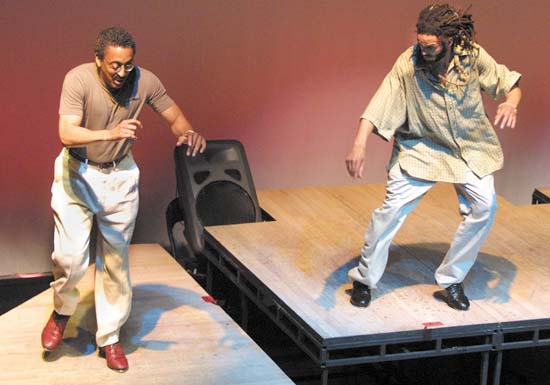
Gregory Hines accepts the 1st Hoofer Award at Tap City 2001
Gregory Hines accepts the 1st Hoofer Award at Tap City 2001
This Summer, July 7th through July 15th, hundreds of tap dancers will converge in the "big apple" for Tap City 2001, the New York City Tap Festival.
We have created a festival that will draw from an international roster of stars and a vast array of recognized performers and ensembles from around the world. The festival will feature tap intensive workshops and training programs at dance studios throughout Manhattan, a series of performances at The Duke on 42nd Street Theater, various panel discussions and film screenings and an innovative children’s program. The highlight of the festival is "Tap City," a star-studded benefit performance on Thursday, July 12th.
This project supports a goal, which is to establish a higher level of understanding and examination of tap dance as an art form, celebrating community and individuality, diversity in age, race, sex, social and economic backgrounds, and our unique American heritage.
The creation of an international tap dance festival in New York City, helps to secure the ultimate preservation of tap dance and perpetuate its growth as a thriving contemporary art form.
Tap City 2001, provides an opportunity to make a positive and lasting statement about New York City and its dedication to this unique American art form. It is now time to pay homage to tap dance by producing a festival in the city known for much of its major development.
Tony Waag and Footage Productions, Inc. Presents:
Stay tuned for new updates
on Master Classes and Tap Courses
during the up coming weekend!
Schedule
Saturday, July 7
Open Jam Session Welcoming Party
Sunday, July 8
Monday, July 9
Today's Highlights:
Tuesday, July 10
Evening Performance - Tap Internationals
Wednesday, July 11
Thursday, July 12
Evening Performance - Tap City Benefit
Friday, July 13
Evening Performance - Tap Masters, Tap Mentors
Saturday, July 14
Ann Kilkelly
Biography:
Writer/dancer/professor Ann Kilkelly teaches at Virginia Tech University in Blacksburg, Virginia, where she is a "Full" Professor in the Theatre Arts Department and The Center for Interdisciplinary Studies. AKA "Bunny," she sheds cap and gown to appear in gender bending comedy, singing, tap dancing, and ukulele playing with her partner Carol Burch-Brown, aka "Tiny Temple," and many others, including singer Elise Witt, percussionist Beverly Bottsford, and Tony Waag's erstwhile alter ego, Lloyd. Burch-Brown and Kilkelly's recent work, "Songs of Our People: the Tourist," has produced near hysteria in a limited number of locations, most recently Knock on Wood Studio in Silver Springs, Maryland.
Ann has studied, written about, performed, choreographed, and taught tap dancing for twenty-five years. Her performance in Laraine Goodman's Vaudeville 2000, "brought the house down," according to Jennifer Dunning of the New York Times.
She has performed in Atlanta, Washington, D.C,. Minneapolis, Madison, New York, Chicago, and many smaller cities in the United States; and in Dubrovnik and Athens (Greece) under the lights of the Parthenon. Events and locations range from concert series at Emory University and Bowdoin College to Conference appearances at Northwestern and New York University, to LaMama and Roulette Intermedia, to the Shamrock Bar in Bluefield West Virginia, in the company of Appalachian drag queens. In Blacksburg, Virginia, she has directed and performed large yearly concerts of original multi-media works with her jazz-tap company, Footnotes. Ann has been a Master Teacher at Dance Week and Sing, Swing, and String Week at the Swannanoa Gathering for five years, and she has belonged to and performed at Alternate Roots Gatherings for fifteen years. Her work is based in jazz-tap, ukulele playing, feminism, and performance theory.
Ann has widely published scholarship in anthologies and journals including (recently), Women and Performance Journal, the ITA newsletter, Millenium Reflections on American Music, edited by Michael Saffle and James Heintze, and Upstaging Big Daddy, edited by Sue Clements and Ellen Donkine. Her poetry and fiction has appeared in The American Voice, Helicon 9, and other small press publications.
Ann's most recent awards include two Senior Smithsonian Fellowships at the Museum of American History, where she and historian Mary Neth are working on the project, Tapping the Margins, to be published as a book under the same title. She has written about women choreographer and performer Brenda Bufalino and others, and is planning a series of articles about contemporary women dancers and choreographers.
Among her teachers and mentors Ann includes Brenda Bufalino, Katherine Kramer, Jane Goldberg, Dianne Walker, and is proud of her early, memorable, and profound experiences in the classes of Eddie Brown, Cholly Atkins, Honi Coles, and Steve Condos.
Cristina Delius
Biography:
Cristina Delius is the director of the tap company Chili con Tap and founder, with partner Anina Kruger, of the tap dance studio TapaToe in Berlin. She performs and teaches workshops outside her studio in Germany, Portugal and Madrid. Her energie and technique combined with her musicality gives her classes or performances a very special touch. TapaToe has become an important dance studio in the world of tap dance. Cristina Delius is one of the ITA representatives in Germany.
Cristina was born in Lisbon, Portugal where she studied dance and music from a very early age. With thirteen she was a member of the dance company Oficina Teatro e Danca with whom she toured and performed in several TV shows. 1983 she received a scolarship from the portuguese government to continue her dance and cello studies in Paris. She discovered tap dance there and studied with Victor Cuno at the Centre de Danse du Marais. She stayed in Paris until 1990.
In New York she had the chance to study with Lesley Lockerey, Barbara Duffy, Brenda Bufalino, and Josh Hilberman. Inspiration sources were as well Chuck Green, Gregory Hines and Buster Brown. Cristina was invited 1997 by Heather Cornell to be a member of M anhattan Tap 2. She performed in New York with Max Pollak, Olivia Rosenkrantz and Michael Minery.
Back to Berlin she founded her own tap company and has worked with tap dancers like Barbara Duffy and Josh Hilberman.
At the moment Cristina is choreographing a new show Lisboa, a cidade e o mar for her company and working on a tap duet with Brenda Bufalino where she will use her cellist skills as well.
Quotes:
Cristina is a very gifted talented tap dancer who is a professional in every sense of the word.
Barbara Duffy
There is one thing that Fred Astaire, Gene Kelly, Cristina Delius and the showcompany Riverdance have in common: speedy feet...
Berliner Morgenpost
Insted of using instruments, Cristina Delius and Anina Krüger make music with her tap shoes and improvise as soloists along with the jazz band...
15 Uhr Aktuell
Cintia Chamecki
Schedule in Tap City 2001:
"A one-woman percussion ensemble"
Jack Anderson, New York Times
Cintia Chamecki performs regularly as a soloist in New York City, Brazil and Japan. She recently completed her first one woman show "Ta No Pe", directed by Susana Ribeiro, which premiered in August 2000 at Teatro Paiol (Curitiba, Brazil), and toured throughout Sao Paulo, Rio de Janeiro and Florianopolis.
She has appeared in New York City in "The Elegance of Tap & The Comedy of Tap," hosted by Bill Irwin (Town Hall-2000), "Vaudeville 2000" (La MaMa E.T.C.) and "Tap Fusion" (Context Studios).
Her own work has been chosen to perform in the renowned "Avant-Garde-Arama" at Performance Space 122, "Movement Research" at the Judson Church, "Crossing Boundaries" at Dixon Place and "17th Annual Downtown Dance Festival" at Battery Park.
In addition to her work as a soloist, Cintia is a member of the Tap Collective (directed by Susan Hebach) and was a featured dancer with the Peggy Spina Tap Company (directed by Peggy Spina). She appeared with the American Tap Dance Orchestra (directed by Brenda Bufalino) in "Gertrude's Nose Tap Opera" and with Manhattan Tap 2 (directed by Heather Cornell) in various shows in the tri-state area.
A native of Brazil, Cintia was co-choreographer, artistic director and soloist of "A Cooperativa da Danca", which she founded with Silvia Lipatin. The company toured Brazil extensively, participating in major festivals in Rio de Janeiro, Sao Paulo, Joinvile, Florianopolis and Campinas. They received the Honor of the Arts from Curitiba City Hall and was awarded the prize for best choreography and performance from Joinvile Dance Festival in 1993, 1994 and 1995.
Cintia is a guest teacher and choreographer in Brazil and Japan, and is currently teaching in the "Tap Dance for Young People" program in New York City.
Cintia would like to give special thanks to those who have influenced her most: Barbara Duffy and Ted Levy
Quotes:
Cintia Chamecki has an "impressive display of rhythm and coordination, daring unique style"
Lisa Jo Sagola, Back Stage
"Brazilian native Cintia Chamecki best personified the elegance of the evening, her feet tracing smooth, uncluttered rhythms, and her hands, while graced with a pair of brilliant cubic zirconia rings from her family's online jewelry business, added to the amazing display of talent and fluidity."
Jody Sperling of The Village Voice
"...incredible musicality that can be achieved when the tapping itself becomes part of the driving rhythm"
Kessa De Santis, Eletronic Link Journey
Tony Wang
Producer/Director of Tap City, the New York City Tap Festival
In 1986, he founded the American Tap Dance Orchestra with Brenda Bufalino and the late Charles ‘Honi’ Coles. As Executive Director and a featured dancer, he toured with the ATDO extensively throughout the United States and around the world. From 1989-1995, he co-created and operated, with Brenda Bufalino, Woodpeckers Tap Dance Center. As a soloist, he has performed internationally, making guest appearances at the International Edinburgh Fringe Festival, Rio de Janeiro’s Tap Encontro 99, The Moscow International Tap Festival, several National Tap Dance Day Extravaganzas in NYC, and numerous other concert events throughout the country. In 2000 and 2001, he performed as Master of Ceremonies to sold-out audiences across the country in Hoagy Carmichael's Centennial Celebration Tour! He has also performed on PBS's GREAT PERFORMANCES – TAP DANCE IN AMERICA, WNEW's P.M. MAGAZINE, GOOD DAY NEW YORK, and THE REGIS & KATHIE LEE SHOW, and has been featured in national television commercials for both Seagram's and Renault. Tony teaches master classes internationally, and is currently working on a new solo show entitled Funny Foot, which celebrates the art of comic dance and pays tribute to the song and dance men of the vaudeville stage and Hollywood musicals.
American Tap Dance Foundation
The American Tap Dance Foundation (ATDF) is a non-profit organization committed to establishing and legitimizing Tap Dance as a vital component of American Dance through creation, presentation, education and preservation.
From 1986 - 1999 the American Tap Dance Foundation was known as the American Tap Dance Orchestra. It was created, choreographed and directed by master tap dancer Brenda Bufalino and founded by Ms. Bufalino along with Tony Waag, and the late Charles ‘Honi’ Coles in 1986 as a tax exempt 501c3 charitable organization. During that time the Orchestra performed in hundreds of concert, stage, and film projects and thrilled audiences around the world. From 1989 to 1995, the company also operated Woodpeckers Tap Dance Center in New York City, and presented on-going classes, performances and related activities. In 2001 with a new generation of tap dancers and enthusiasts, the Orchestra was renamed under the artistic direction and leadership of Tony Waag.
ATDF programs include: • Tap City, the annual New York City Tap Festival • the Tap City Youth Ensemble • Concert Performances & National Tours • the Gregory Hines Youth Scholarship Fund • the International Tap Dance Hall of Fame • Annual Hoofer & Tap Preservation Awards • the Gregory Hines Collection of American Tap Dance archives at the Lincoln Center Library
American Tap Dance Center opened in 2010 as the home to the American Tap Dance Foundation, and offers year-round educational programs including: • Tap Dance Conservatory • Teacher Training Certificate Program • Ongoing Classes for Youth, Teens & Adults • Tap Choreography Intensives & Showcases • Master Workshops for Professionals • Artists In Residence Program • Reconstruction & Choreography Commission Projects • Rental Space for rehearsals • Tap Talks, Jams & Film Presentations

More Background On NYCTapFestival.com
NYCTapFestival.com emerged at a pivotal moment in the cultural history of American tap dance, serving as the official online home for what would become one of the most influential tap festivals ever staged in New York City. The website documented and promoted the New York City Tap Festival—widely branded as Tap City—which took place in July 2001 and marked a watershed moment in the recognition of tap as a serious, contemporary art form rooted in American cultural history.
At the dawn of the 21st century, tap dance occupied an unusual position: revered by historians and elder performers, celebrated internationally, yet often marginalized within mainstream American dance institutions. NYCTapFestival.com was designed not merely as a promotional tool but as a cultural declaration—asserting New York City’s rightful role as the spiritual and historical epicenter of tap dance innovation.
The site framed the festival as both a celebration and a corrective: an effort to re-center tap dance in the city where it had flourished in vaudeville houses, Harlem ballrooms, Broadway stages, and jazz clubs throughout the 20th century.
Ownership, Leadership, and Institutional Backing
NYCTapFestival.com was produced under the direction of Tony Waag, a respected tap dancer, producer, educator, and preservationist whose career bridged performance, scholarship, and arts administration. Waag’s leadership was instrumental in shaping the festival’s dual identity as both a world-class performance event and a pedagogical initiative.
The festival was presented by Footage Productions, Inc. and closely aligned with the mission of the American Tap Dance Foundation (ATDF), a nonprofit organization devoted to the creation, presentation, education, and preservation of tap dance. ATDF’s involvement placed the festival within a broader institutional framework dedicated to archiving tap history, supporting new work, and mentoring emerging artists.
This organizational foundation distinguished the New York City Tap Festival from many regional dance festivals. It was not conceived as a one-off event but as part of a sustained, long-term strategy to legitimize tap dance within American cultural institutions.
Location, Venues, and Urban Context
NYCTapFestival.com emphasized Manhattan as both stage and subject. The festival unfolded across multiple iconic New York City locations, including professional dance studios throughout Manhattan and major performance venues such as the Duke on 42nd Street Theater (now the New Victory Theater).
By situating performances, workshops, panels, and screenings across the city, the festival embedded tap dance within New York’s daily cultural rhythm. Participants were not isolated in a single venue but moved through the city much as tap dancers historically had—between rehearsal studios, theaters, and informal jam sessions.
The website highlighted proximity to Broadway, Times Square, Lincoln Center, and Harlem, underscoring the festival’s connection to neighborhoods historically central to tap’s development. This geographic framing reinforced the idea that tap dance belongs not on the margins but at the heart of New York City’s cultural life.
Festival Programming and Structure
NYCTapFestival.com provided a meticulously detailed schedule reflecting the festival’s ambitious scope. Over more than a week, Tap City 2001 offered:
-
Intensive master classes for professional and advanced dancers
-
Multi-level tap courses spanning technique, rhythm, and improvisation
-
Children’s programs designed to cultivate the next generation of tap dancers
-
Panel discussions addressing history, gender, race, and aesthetics in tap
-
Film screenings documenting tap’s evolution on stage and screen
-
Evening performances curated around thematic programming
Each day was structured to balance physical training, intellectual engagement, and performance. This holistic approach reflected the festival’s belief that tap dance is simultaneously a physical discipline, a musical form, and a cultural language.
The Tap City Benefit and Signature Performances
At the center of the festival was the Tap City Benefit performance, positioned as both a celebratory showcase and a fundraising event supporting tap preservation initiatives. NYCTapFestival.com described this evening as a star-studded gathering of master hoofers, contemporary innovators, and international artists.
The benefit was emblematic of the festival’s ethos: honoring elders while providing a platform for emerging voices. Rather than privileging a single aesthetic, the programming embraced stylistic plurality—traditional Broadway tap, jazz-inflected improvisation, experimental hybrids, and global tap dialogues.
This inclusive philosophy helped redefine what a tap festival could be, shifting expectations from nostalgic revue to forward-looking cultural symposium.
Artists, Educators, and International Reach
One of the defining characteristics of NYCTapFestival.com was its extensive artist documentation. The site featured detailed biographies of performers, teachers, and choreographers from across the United States, Europe, South America, and beyond.
These profiles emphasized not celebrity alone but lineage—who studied with whom, which traditions were being carried forward, and how tap knowledge was transmitted across generations and borders. This genealogical framing reinforced tap’s status as a living, evolving art form with deep roots.
The presence of international artists underscored the global reach of American tap dance by 2001. Far from being a localized or retro genre, tap had become a transnational practice, and the New York City Tap Festival positioned itself as a global meeting point.
Gender, Diversity, and Cultural Representation
NYCTapFestival.com devoted significant attention to issues of gender, race, and representation. Panels such as “Women in Tap” and film programs highlighting underrepresented histories reflected a conscious effort to broaden tap’s narrative beyond a narrow canon.
Tap dance, born from African American rhythms and shaped by immigrant performance cultures, carries complex social histories. The festival’s programming acknowledged these roots while celebrating diversity in age, race, gender identity, and socioeconomic background.
This commitment to inclusivity was not merely rhetorical. It shaped casting decisions, educational content, and institutional priorities, positioning the festival as both an artistic and social intervention.
Audience and Community Engagement
The website made clear that the festival’s audience extended beyond professional dancers. NYCTapFestival.com addressed:
-
Working tap professionals
-
Dance educators and students
-
Scholars and historians
-
Families and young dancers
-
General audiences interested in American music and performance
Children’s programs were prominently featured, reflecting the belief that preservation depends on education. By introducing young participants to master artists and historical context, the festival sought to ensure tap’s continuity into future generations.
Community jam sessions and informal gatherings further blurred the line between performer and audience, reinforcing tap’s roots as a participatory, communal art form.
Press, Public Recognition, and Cultural Endorsements
NYCTapFestival.com prominently featured endorsements and coverage that lent the festival national visibility. Public statements of support from cultural figures and policymakers underscored tap’s broader cultural importance.
Of particular note was the involvement of Hillary Rodham Clinton, whose public message of encouragement symbolized institutional recognition of tap dance as part of America’s cultural heritage.
Equally significant was the presence of Gregory Hines, who accepted the inaugural Hoofer Award at Tap City 2001. Hines’s participation carried enormous symbolic weight, linking the festival to tap’s golden age while affirming its contemporary relevance.
Awards and Legacy Initiatives
The New York City Tap Festival was closely tied to a constellation of awards and preservation efforts administered by the American Tap Dance Foundation. These included the Hoofer Awards and later initiatives honoring lifetime achievement, mentorship, and historical contribution.
NYCTapFestival.com framed these honors not as nostalgic gestures but as active components of cultural preservation. Recognizing elders publicly validated tap’s history and provided younger dancers with visible role models.
The festival also aligned with archival initiatives, including the Gregory Hines Collection of American Tap Dance, reinforcing its role as both celebratory event and historical steward.
Cultural and Social Significance
The broader significance of NYCTapFestival.com lies in what it represented at a transitional moment. In 2001, tap dance stood at a crossroads—rich in history yet vulnerable to marginalization. The festival asserted that tap belongs alongside ballet, modern, and contemporary dance as a serious, evolving art form.
By grounding its mission in education, preservation, and innovation, the festival challenged reductive perceptions of tap as mere entertainment. It positioned tap as music made visible, rhythm embodied, and history spoken through sound.
NYCTapFestival.com captured this philosophy in digital form, functioning as both archive and manifesto.
Website Design, Structure, and Archival Value
From a digital-history perspective, NYCTapFestival.com exemplifies early-2000s arts web design: text-forward, schedule-driven, and information-dense. While visually modest by contemporary standards, the site’s depth of content makes it a valuable archival resource.
Artist biographies, schedules, mission statements, and contextual essays collectively form a snapshot of tap culture at a specific historical moment. For researchers, educators, and practitioners, the site offers insight into how tap was framed, taught, and institutionalized at the turn of the century.
Its continued availability through archival platforms underscores the enduring relevance of its content.
Why NYCTapFestival.com Still Matters
NYCTapFestival.com stands as more than a record of a single event. It documents a cultural assertion—that tap dance is central to American artistic identity and that New York City remains its beating heart.
Through its leadership, programming, educational initiatives, and institutional partnerships, the New York City Tap Festival reshaped expectations for what tap festivals could achieve. The website preserves that achievement, offering future generations a window into a moment when tap stepped confidently into a new century.